
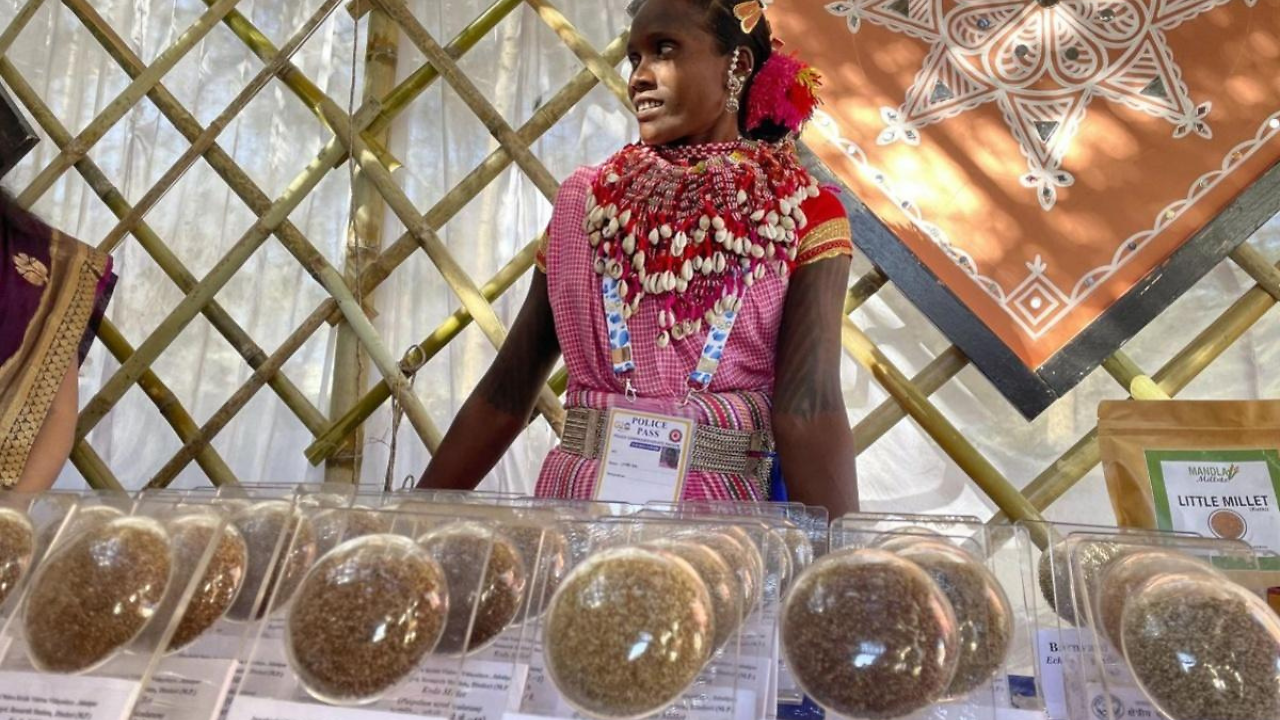
World Tribal Day: Meet Lahari Bai, India’s Celebrated ‘Millet Ambassador’ (Credit – IndiaTimes)
The intricate bond between the tribe and their natural surroundings is exemplified by Lahari Bai, a 27-year-old Baiga woman. Celebrated as India’s “millet ambassador,” Lahari manages a seed bank and a so-called “doomsday vault” right from her two-room house in the Silpidi village. Spanning approximately three acres of land, her endeavour aims to conserve various types of millet from the threat of extinction. Through her relentless efforts, she is credited with preserving as many as 150 indigenous millet species. In 2022 alone, Lahari reportedly distributed these vital seeds to 350 farmers, benefiting 25 villages in her district.
In Baigachak—a region that encompasses seven Baiga villages including Silpidi—community-based seed collectives are a familiar sight. Local women, including Lahari Bai who serves as the secretary for one such group, the Sawa Salhar Sanghati Beej Bhandar Samiti Silpidi, spearhead the efforts to gather and share diverse seeds for “bewar” agriculture. In 2021, the Samiti piloted the farming of three specific millet types—mandia, salhar, and bajra—across three test plots. At the end of the farming cycle, the involved farmers contributed six kilograms of seeds back to the cooperative. As of the current year, the Samiti is actively distributing at least eight different seed varieties, such as bhursa, katki kang, dongar, kali kutki, and finger millets like lal and chawal madia, in addition to the initially cultivated varieties of salhar, bajra, and kodo.
 Millets (Credit – Freepik)
Lahari’s work extends beyond merely reviving the Baiga tribe’s native millets; she’s also committed to conservation, a fact her peers readily acknowledge. She initiated her campaign about ten years ago, drawing on the wisdom and practices concerning agriculture and diet that she learned from her grandmother. In one room of her home, clusters of millets are suspended from the ceiling for drying, while large earthenware jars—each labelled with the name of the seeds they hold—are arranged along the walls. When Lahari shares seeds with local farmers, a simple exchange takes place: for every kilogram of seeds she distributes, the farmers are expected to return 1.5 kilograms of the same or a different millet variety come harvest time. Inspired by her efforts, at least 40 other women in the area have adopted Lahari’s approach. They are not only focusing on millets but are also diversifying into pulses, oilseeds, and vegetables that have traditionally been part of the Baiga’s agricultural heritage.
You can read the original news here: Source link


