
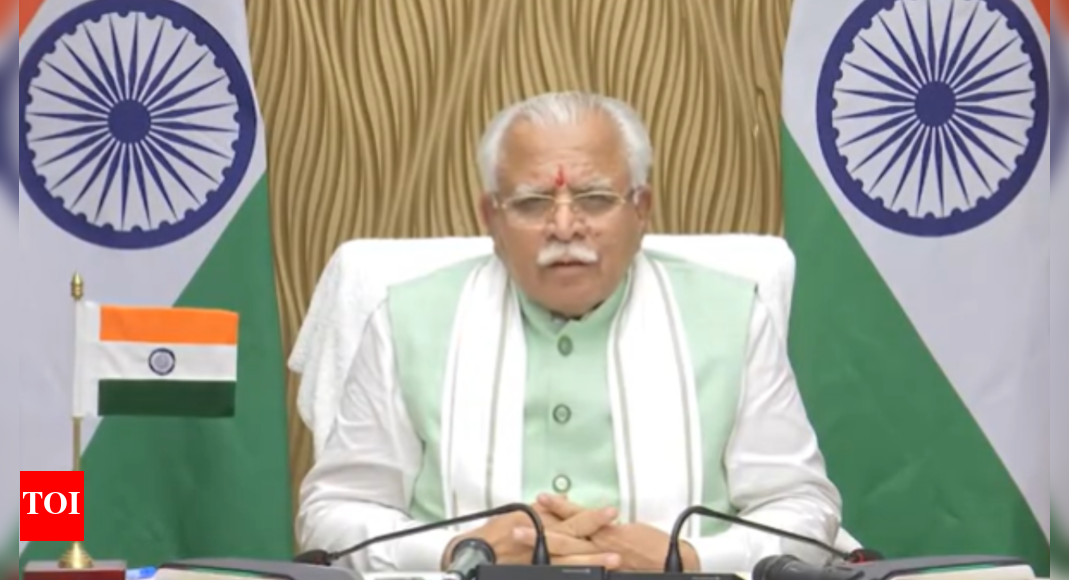
CHANDIGARH: Haryana chief minister Manohar Lal Khattar on Saturday announced the disbursement of Rs 830 crores to millet farmers under the Bhavantar Bharpayee scheme.
The prosperity of both the state and the nation is intricately linked to the well-being of farmers. Consequently, formulating and implementing continuous welfare schemes for farmers remains a central focus of the Haryana government.
The government is dedicated to providing comprehensive support to farmers, encompassing all stages from crop preparation to marketing.
This initiative has already disbursed a substantial amount of Rs 33.26 crore to over 1,20,000 farmers engaged in fruit and vegetable cultivation, said Manohar Lal while interacting with the beneficiaries of Bhavantar Bharpayee Yojana through audio conferencing held today at Gurugram as a part of the ongoing ‘CM ki vishesh Charcha’ programme.
The chief minister emphasized the importance of acknowledging farmers who have boldly ventured into new and successful farming experiments.
He mentioned that these farmers have inspired others to break away from the conventional wheat and paddy cycle. He noted that while the farmer produces the crop, there used to be uncertainty about market prices. Many times, they were left in precarious situations and were forced to sell the crop at a price less than the cost.
“To combat this issue, the state government introduced the Bhavantar Bharpayee Yojana, initially for fruits and vegetables (since January 2018), and later for millets (from Kharif-2021). This pioneering scheme ensures that farmers are informed about a guaranteed price even before planting their crops. When market prices for millets fall below the Minimum Support Price (MSP), the government steps in to bridge the gap by providing the difference directly to the farmers’ accounts,” said the chief minister.
He said that among the farmers he is interacting with today are also millet growers. On the initiative taken by Prime Minister Narendra Modi, the United Nations has declared the year 2023 as the International Millet Year.
“Coarse grains are good for health, so today the trend of consuming them has increased among health-conscious people, and their demand has increased not only in the country but also abroad. We are also promoting the production of millets in Haryana and have ensured remunerative prices for the farmers,” said Manohar Lal.
The chief minister stated that before the Kharif-2021 season, the government was engaged in the procurement of millet at the MSP.
However, neighboring states did not participate in this procurement initiative. There were reports indicating that unscrupulous traders took advantage of the situation by purchasing Bajra from neighboring states at lower prices and then selling it in Haryana at MSP rates, he said.
“To address this issue, the state introduced the Bhavantar Bharpayee Yojana, which aimed to ensure fair pricing for millet. Additionally, another challenge emerged in the form of millet’s limited storage life. If not used within 4 to 6 months, its quality deteriorates. Moreover, millet has restricted usage in industries, leading to a surplus being sold to poultry farms at significantly reduced prices. This combination of factors resulted in an extra financial burden of Rs 825 crore on the state government for resolution,” Khattar said.
The CM said that Bhavantar has been compensated based on the average productivity per acre of Bajra. If the farmer did not bring his produce to the market, waited for a reasonable price, and kept the millet for his own use, he was paid the difference.
He informed that in Kharif season-2021, the minimum support price of millet was Rs 2,250 per quintal, and the average market price was Rs 1,650 per quintal. Compensation was provided at the rate of Rs 600 per quintal. In Kharif-2021, an amount of Rs 440 crore was directly deposited into the accounts of 2,42,948 farmers as Bhavantar Bharpayee.
“The MSP of bajra in Kharif-2022 was Rs 2,350 per quintal, and the average market price was Rs. 1,900 per quintal. Compensation was provided at the rate of Rs 450 per quintal. In Kharif-2022, an amount of Rs 390 crore was directly deposited into the accounts of 2,76,620 lakh farmers as Bhavantar Bharpayee. In this way, Rs. 830 crore was directly deposited into the accounts of the farmers who produced Bajra in two seasons,” the chief minister said.
The target is to double the horticulture area and triple the production by the year 2030.
Khattar said that today land holdings are getting smaller. The only way to make small land holdings profitable is for farmers to move towards horticulture and take up the cultivation of fruits, vegetables, and flowers.
“Our target is to double the area under horticulture to 22 lakh acres and triple the production by the year 2030. I am sure that with the cooperation of hardworking farmers like you, we will be able to achieve this goal,” Khattar said.
The Chief Minister said that the state government has ensured that horticulture farmers do not have to bear the brunt of fluctuating market prices. For this, a protected price has been fixed for horticulture crops under the Bhavantar Bharpayee Yojana. With this system, the farmer gets to know at the time of sowing how much income he will get per acre.
Mukhyamantri Bagwani Bima Yojana
The chief minister said that farmers have to bear heavy crop losses due to adverse weather conditions. To address this, the government has started the Pradhan Mantri Fasal Bima Yojana and Mukhyamantri Bagwani Bima Yojana to save farmers from the risk of weather uncertainties. This includes 21 horticulture crops. Under this, Rs 75,000 per hectare claim amount is being provided for vegetables and Rs 1 lakh for fruits.
“Farmers have received Rs 50,000 crore through DBT”
The Chief Minister said that there was a time when farmers faced challenges in receiving their rightful payments for their crops. Often, the money got transferred to the wrong accounts, leaving them at the receiving end. However, the present government has put an end to this practice. Approximately Rs 50,000 crore has been directly transferred to farmers’ accounts through DBT. When farmers sell their crops now, the money is promptly deposited into their accounts.
The chief minister also expressed gratitude to Prime Minister Narendra Modi for introducing the Kisan Samman Nidhi, providing Rs 6,000 as assistance to farmers.
He said that the state government installed about 53,000 solar pumps in the state last year, and farmers were given subsidies for these pumps. This year, 70,000 new solar tube wells will be installed. This will also reduce electricity consumption and provide significant benefits to farmers, Khatter added.
You can read the original news here: Source link


